
Why Bother Coating Neodymium Ring Magnets Anyway?
Here’s something a lot of people learn the hard way. Neodymium Ring magnets hate moisture. Leave a bare ring on a damp bench overnight, and by morning you’ll see little rust spots. Leave it for a week, and it starts flaking. I’ve seen uncoated rings in a shipping container — just humidity, no rain — turn into a mess of brown powder in two weeks. That’s why coatings exist. Not to make them look pretty. To keep them alive.
Stopping Rust Before It Starts
The whole point of a coating is simple: keep water and oxygen away from the metal. But here’s where it gets tricky. A ring magnet inside a sealed sensor housing? Almost no risk. The same magnet on a tow truck holding signs? Gets rained on, splashed with road salt, maybe dropped in a puddle. One tiny scratch in the coating, and rust starts eating from the inside out. I had a customer call me once — he’d used nickel-coated rings on a boat dock. Six months later, the magnets looked fine on the outside but were swollen and cracked open. Rust underneath had pushed the coating apart. That’s why for wet jobs, you don’t mess around. You go epoxy or multi-layer nickel (the kind with copper in the middle).
Does a Coating Weaken the Magnet?
Short answer: not really. Coatings aren’t magnetic, but they don’t block the field either. However — and this is a big “however” — thickness adds distance. Think of it this way. A bare magnet touches the steel directly. Add a 30-micron epoxy coat, and now there’s a tiny gap. For most uses, you’ll never notice. But if you’re stacking rings or building a magnetic coupling with tight tolerances, that extra 0.06 mm can drop holding force by a few percent. We learned this from a customer who kept complaining about slipping couplings. Turned out his design assumed bare magnets, but the epoxy-coated rings he ordered added just enough gap to mess up the torque.
The Three Coatings You’ll Actually See
Nickel (The Default Choice)
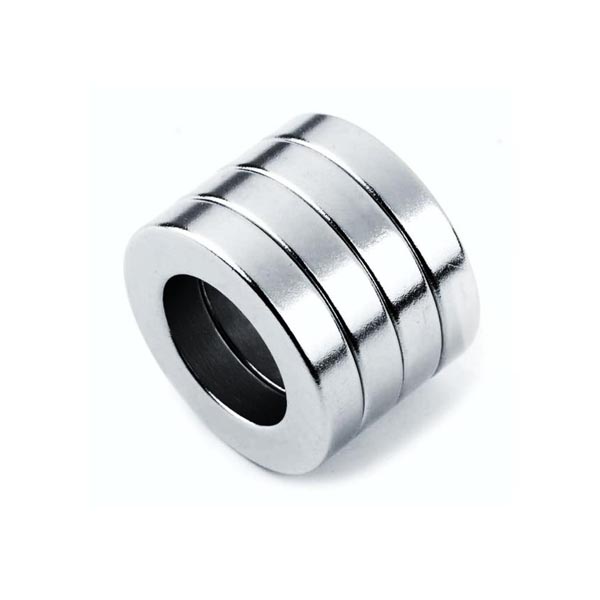
Walk into any magnet shop, and most of what you’ll find has nickel on it. It’s actually three layers: nickel, then copper, then nickel again. That sandwich stops rust pretty well for everyday indoor use. It’s hard, it’s shiny, and it doesn’t scratch too easily. Most Neodymium Ring Magnets you buy off the shelf come this way. Good for workshop tools, sensors, magnetic holders, that kind of thing. But nickel has a weakness: salt. If you’re near the ocean or your hands sweat a lot, nickel will eventually pit and fail. Also, it conducts electricity. Fine for most people, but don’t put it near sensitive electronics where a short could fry something.
Epoxy (The Heavy-Duty Option)
Epoxy is the tough guy. Usually black or dark gray. It’s baked on after spraying or dipping. I’ve seen epoxy-coated rings sit for months in a coolant tank — the same tank that turned nickel rings into rusty junk in three weeks. Epoxy also takes hits better. If you drop a magnet onto a steel plate, nickel can chip. Epoxy just shrugs it off. Downside? It’s thicker. You lose a little magnetic performance because of the extra gap. And epoxy doesn’t like direct sunlight. Leave it outside for a year, and it gets yellow and brittle. Fine for indoors or covered outdoor use. Not great for constant UV exposure.
Zinc (The Budget Pick)
Zinc is what you buy when price matters more than anything else. It’s a thin electroplated layer, maybe 5 to 10 microns. Works okay in a dry warehouse or inside a product that never sees moisture. But scratch it — and you will — and the magnet underneath rusts fast. I’ve had customers try to save fifty bucks on a thousand rings by choosing zinc. Then they got returns from people who stored the magnets in a garage. Humid garage, rusty magnets, angry customers. Zinc has its place. Just know that place is not anywhere wet.
How to Pick the Right Coating for Your Job
Think About Where It’s Going
Don’t guess. Walk through the real life of that magnet. Will it ever be outside? Get rained on? Sit next to a chemical? See salt spray? Grease? Sweaty hands? Each answer pushes you to a different coating.
- Dry indoor, low humidity – Zinc is fine. Save your money.
- Humid or occasional dampness – Nickel works. This covers most shops and factories.
- Outdoor, marine, chemical exposure – Epoxy. Or specialty coatings like Parylene (expensive, but available on custom orders).
- Hot environments – Here’s the catch. Standard nickel and epoxy start breaking down above 120–150°C. If your rings live near a motor or an oven, you need high-temperature magnets first. Then you need a coating rated for that heat. I’ve seen epoxy soften and peel off rings inside a drying oven. The magnet was still magnetic. The coating just slid off like wet paint.
Thickness: Small Number, Big Headache
Thickness sounds boring until it ruins your fit. A ring magnet slides over a shaft. With a 15-micron nickel coat, no problem. With a 40-micron epoxy coat, suddenly it doesn’t fit anymore. We had a job once where the customer sent us a drawing for bare magnets. Then they ordered epoxy-coated rings. The inner diameter came out 0.08 mm smaller than they expected. Nothing would slide onto the shaft. Now we always ask: “Do you want coating on all surfaces, or do you want us to mask the inner diameter?” For ring magnets, everything gets coated unless you say otherwise. If you need exact clearance, order samples. Measure them with a caliper. Don’t assume.
How Coatings Get Put On (And Why Quality Varies)
The Two Ways to Plate Magnets
Most cheap magnets get barrel plated. Throw a bunch of rings in a rotating barrel with plating solution. It’s fast and cheap. But the rings bump into each other. Edges chip. Those tiny chips become rust spots later. Better manufacturers use rack plating. Each magnet sits on its own rack. Slower. More expensive. But the coating is even, and there are almost no defects. For epoxy, it’s usually sprayed or dipped, then baked. The tricky part with rings is the hole in the middle. Cheap spray rigs miss the inside bore. Good shops use special nozzles or multiple passes to get full coverage inside the hole.
What Tests Should Your Supplier Run?
Don’t just trust them. Ask questions. Here’s what matters:
- Salt spray test – How many hours before rust shows up? 24 hours is weak. 72+ hours is what you want for epoxy.
- Adhesion test – Scratch the coating. Does it flake off like old paint? That’s bad.
- Thickness check – Every batch, not once a year. And they should tell you the tolerance.
I’ve walked away from suppliers who couldn’t answer “What’s your coating thickness tolerance?” That’s a huge red flag. For bulk orders, put it in writing: “Measure 5 samples per batch. Nickel tolerance ±5 µm. Epoxy tolerance ±10 µm.” If they push back, find someone else.
What You Must Confirm Before Ordering Coated Ring Magnets
Dimensions With or Without Coating?
This sounds basic, but it gets messed up all the time. A bare magnet might measure 20 mm outer diameter, 10 mm inner diameter, 5 mm thick. Add 20 microns of nickel, and now the finished OD is 20.04 mm, and the ID is 9.96 mm. That 0.04 mm can be the difference between a snug fit and no fit at all. On your drawing, write clearly: “All dimensions are after coating unless marked otherwise.”
Which Way Is It Magnetized?
Ring magnets can be magnetized through the thickness (axial) or across the diameter (diametric). The coating doesn’t change the magnetization direction of Ring magnets. But if the coating is uneven, a spinning ring can wobble. For diametrically magnetized rings going into motors, tell your supplier: “Coating thickness variation must be under 5 microns.” Otherwise, you might get vibrations.
Exactly Which Coating Do You Want?
Don’t just say “nickel.” Say “triple-layer nickel-copper-nickel, 15 to 20 microns, pass a 48-hour salt spray test.” Be that specific. And before you order thousands, get a sample. Test it in your real environment. Soak it. Scratch it. Freeze it. A $50 sample can save you $5,000 in scrap.
Custom Manufacturing: How It Actually Works
The Build-to-Print Process
For precise custom neodymium magnets, it’s important to specify the required coating along with other dimensions and tolerances. Here’s how it usually goes. You send a drawing or a 3D file. It shows the ring dimensions, coating type, thickness, and any areas you want masked (like leaving the inner hole bare for a press fit). The shop makes a small batch of prototypes. You test them. Then, and only then, they run full production. This is standard for orders above 20,000 to 50,000 pieces. Smaller orders? They might start with stock rings and add a custom coating.
MOQ and Lead Time: What to Expect
Coating changes how many you have to order and how long you wait. Zinc and nickel are easy — MOQ might be 1000 to 5000 rings, lead time 2 to 4 weeks. Epoxy needs more setup. Usually 5,000 to 10,000 pieces minimum, and 4 to 6 weeks. Want something weird like gold, tin, or Parylene? Possible, but only for big orders (50,000+) and long lead times (6 to 8 weeks). Always ask the question: “What’s your MOQ for this coating on my specific ring size?” Then add two weeks to whatever they tell you. Delays happen. I’ve never seen a coating job come in early.
Got a tricky ring magnet project? Let’s talk about your environment, your volume, and your budget. We’ve made enough mistakes to know what works!
Your Custom Neodymium Magnets Project
We can offer the OEM/ODM services of our products. The product can be customized according to your personalized requirements, including the size, Shape, performance, and coating. please offer your design documents or tell us your ideas and our R&D team will do the rest.
Other Types of Magnets



Post time: Apr-10-2026