
When people discuss neodymium magnets, conversations usually revolve around magnetic grades such as N35, N42, or N52. Pull force, temperature resistance, and dimensional tolerances often receive the most attention during product development.
Yet after years of supporting OEM manufacturers, automation companies, medical device suppliers, and industrial distributors, our team at Fullzen Technology has noticed something interesting: many magnet failures have little to do with magnetic strength.
Instead, they begin with corrosion.
A magnet can check all the boxes for magnetic performance on paper. But a poor coating choice lets moisture, chemicals and environmental impurities eat away at the base material. Once rust shows up, the component has already sustained hidden damage.
That is why experienced engineers rarely evaluate a neodymium magnet without also considering its surface protection system.
In this article, we compare the most common coating options used on NdFeB magnets and explain how coating decisions are typically made in real manufacturing projects.
Why Do Neodymium Magnets Need Protective Coatings?
Neodymium magnets are crafted from a blended alloy of neodymium, iron and boron. Among all commercially produced permanent magnets, this material boasts an extremely high magnetic energy output. Its main downside, though, is a strong tendency to oxidize when exposed to air.
Anyone who has handled an unfinished NdFeB magnet knows how quickly surface discoloration can appear when the material is exposed to moisture.
Without protection, corrosion may lead to:
- Surface rust formation
- Chipping around edges
- Reduced mechanical strength
- Structural cracking
- Premature failure of magnetic assemblies
For manufacturers, this creates a challenge. The magnetic material itself performs exceptionally well, but only if it is properly isolated from the surrounding environment.
This is where coatings and platings become critical.
Although these terms are often used interchangeably, they are not exactly the same.
Metallic platings such as nickel and zinc are deposited through electrochemical processes, while coatings such as epoxy and parylene form protective barrier layers over the magnet surface.
Both approaches serve the same purpose: protecting the magnet from environmental damage.
The First Question Engineers Ask
Customers frequently ask us:
“What is the best coating for neodymium magnets?”
The answer depends entirely on where the magnet will be used.
A magnet inside a Bluetooth speaker faces completely different conditions than a magnet installed inside an automotive sensor exposed to road salt, temperature cycling, and humidity.
Rather than searching for the strongest coating available, engineers usually evaluate three practical questions:
- How much moisture will the magnet encounter?
- Will chemicals or cleaning agents be present?
- What service life is expected?
Once these factors are understood, coating selection becomes much more straightforward.
Comparing the Most Common Neodymium Magnet Coatings
The following table provides a general comparison of commonly used coating systems.
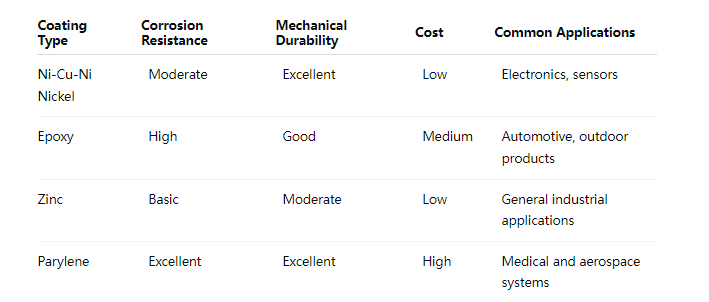
While tables provide a useful overview, real-world performance depends on much more than laboratory specifications.
Understanding how each coating behaves in actual applications is far more valuable.
Nickel Plating: The Go-To Solution for Commercial Magnets
Take apart ordinary electronic devices, and you will almost certainly spot magnets with nickel plating inside.
This surface treatment has long become the industry benchmark, and for good reason. It strikes a great balance between protective performance, visual appeal and affordable pricing.
The majority of nickel-plated magnets adopt a three-layer structure: nickel on the outside, copper as the middle layer, and another nickel base layer, commonly known as Ni-Cu-Ni.
The finished surface is sleek and neat, and stands up well to friction during assembly work. On top of that, this plating process runs efficiently and works perfectly for mass production.
Even so, many design engineers fall into a common trap: they believe nickel plating works reliably in all scenarios.
This is not the case.
We once worked on outdoor monitoring devices, where the client initially chose standard nickel-plated magnets. They picked this option mainly for its easy availability and low cost. After running field tests for months in humid surroundings, corrosion started to spread around minor surface scratches.
While the magnets still retained full magnetic power, their look and long-term stability were compromised.
This real case points out a key rule:
Nickel plating works wonderfully in dry indoor settings, but its reliability drops noticeably when exposed to high moisture.
All the same, it remains an excellent pick for indoor electronics, sensors, home appliances and general consumer goods.
Why Epoxy Coatings Are Favored by Automotive Designers
When humidity and moisture pose major threats, epoxy coating is usually the next choice engineers turn to.
Different from metal plating, epoxy forms a solid isolating film that shields the magnet core from outside elements. This advantage proves extremely valuable for automotive applications.
Vehicles constantly face harsh conditions: road salt, condensed water, rainfall and drastic temperature changes. These environments are far harsher than typical indoor spaces for electronics or office gear.
Quite a number of automotive clients switched to epoxy-coated magnets after running into corrosion problems with regular nickel plating.
The reason is simple.
Epoxy coatings generally achieve substantially higher salt spray performance and provide a stronger defense against moisture penetration.
Of course, no solution is perfect.
Epoxy surfaces can be scratched during handling if proper packaging and assembly procedures are not followed. For this reason, coating quality and transportation methods remain important factors.
Despite this limitation, epoxy remains one of the most effective solutions for outdoor and high-humidity environments.
Typical applications include:
- Automotive sensors
- Renewable energy equipment
- Agricultural machinery
- Outdoor lighting system
- Marine electronic assemblies
Parylene: The Choice for High-Reliability Applications
Some projects demand a level of protection beyond what traditional coatings can provide.
This is where parylene enters the discussion.
Unlike liquid coatings or electroplated finishes, parylene is deposited through a vapor-phase process. The material forms an extremely thin and uniform protective layer across the entire surface of the magnet.
From an engineering perspective, one of parylene's biggest advantages is coverage consistency.
Corners, edges, recesses, and complex geometries all receive nearly identical protection.
Medical device manufacturers often prefer parylene because of its biocompatibility and exceptional barrier properties.
We have seen applications involving diagnostic equipment and surgical instruments where coating reliability was considered just as important as magnetic performance itself.
The primary disadvantage is cost.
Parylene processing requires specialized equipment and additional production steps, which increases manufacturing expenses.
However, when product failure is unacceptable, the additional investment is often justified.
Is Zinc Plating Still Relevant?
Although zinc plating receives less attention today, it continues to serve a purpose in certain applications.
For projects where cost is the dominant factor and environmental exposure is limited, zinc remains a practical option.
Some industrial customers choose zinc-plated magnets for temporary assemblies, promotional products, or applications where long-term corrosion resistance is not critical.
Compared with nickel plating, zinc typically provides lower durability and less aesthetic appeal.
However, for budget-sensitive projects, it can still be a reasonable choice.
What Causes Coating Failure?
Selecting a coating is only part of the equation.
Even the best coating can fail if the application environment is misunderstood.
The most common issues we encounter include:
Edge Damage
Magnet corners are particularly vulnerable during assembly and transportation.
Once the protective layer is damaged, corrosion can begin underneath the surface.
Moisture Penetration
Tiny coating defects may allow water to reach the NdFeB substrate.
Over time, corrosion spreads beneath the protective layer.
Poor Adhesion
If surface preparation is inadequate during manufacturing, coatings may separate from the magnet under thermal or mechanical stress.
Chemical Exposure
Certain solvents, cleaning agents, and industrial chemicals can degrade protective layers faster than expected.
Understanding these risks often helps engineers make better coating decisions than simply comparing specification sheets.
Real Examples of Coating Selection
In practice, coating decisions are usually driven by environmental conditions.
Consumer Electronics
Environment:
- Indoor use
- Controlled humidity
- Limited exposure to contaminants
Typical choice:
Ni-Cu-Ni nickel plating
Outdoor Monitoring Equipment
Environment:
- Rain
- Condensation
- Seasonal temperature changes
Typical choice:
Epoxy coating
Medical Equipment
Environment:
- Sterilization procedures
- Sensitive operating conditions
Typical choice:
Parylene coating
Cost-Sensitive Industrial Components
Environment:
- Basic protection requirements
Typical choice:
Zinc plating
How We Help Customers Select Coatings
At Fullzen Technology, coating selection is typically discussed during the early design stage.
Rather than recommending a coating based solely on cost, we usually review:
- Installation environment
- Temperature conditions
- Exposure to moisture
- Chemical contact risks
- Expected service life
- Regulatory requirements
This approach often prevents expensive redesigns later in the project.
A coating that costs slightly more during production may significantly reduce warranty claims and maintenance expenses throughout the product lifecycle.
Why Manufacturers Work with Fullzen Technology
Surface protection is only effective when supported by consistent manufacturing processes.
For this reason, our production team focuses not only on coating selection but also on coating quality control.
Our capabilities include:
- Custom neodymium magnet manufacturing
- Coating thickness inspection
- Salt spray testing support
- Dimensional verification
- Automotive project support
- Medical application support
- Global export experience
Whether a project requires standard nickel plating or advanced coating solutions, our engineering team works with customers to identify the most suitable option based on actual operating conditions.
Frequently Asked Questions
Which coating is best for outdoor neodymium magnets?
In most outdoor applications, epoxy coatings provide the best balance between corrosion resistance and cost.
Is parylene better than epoxy?
Parylene generally offers superior barrier protection and uniform coverage, but it is more expensive. The best choice depends on the application's performance requirements.
Can nickel-plated magnets rust?
Yes. Although nickel plating provides protection, corrosion can still occur if the plating becomes damaged or if the magnet is exposed to aggressive environments.
What coating is commonly used for medical devices?
Parylene is frequently selected because of its biocompatibility and high reliability.
Does coating affect magnetic strength?
Under normal circumstances, coating selection has minimal impact on magnetic performance. Its primary function is environmental protection.
Conclusion
There is no single coating that is ideal for every neodymium magnet application.
Nickel plating remains an excellent solution for indoor products. Epoxy coatings offer stronger protection in humid and outdoor environments. Parylene provides premium performance for medical and mission-critical systems, while zinc continues to serve cost-sensitive industrial applications.
The most successful projects begin by understanding the environment first and selecting the coating second.
By matching surface protection to real operating conditions, engineers can significantly improve reliability, reduce corrosion-related failures, and extend product service life.
Your Custom Neodymium Magnets Project
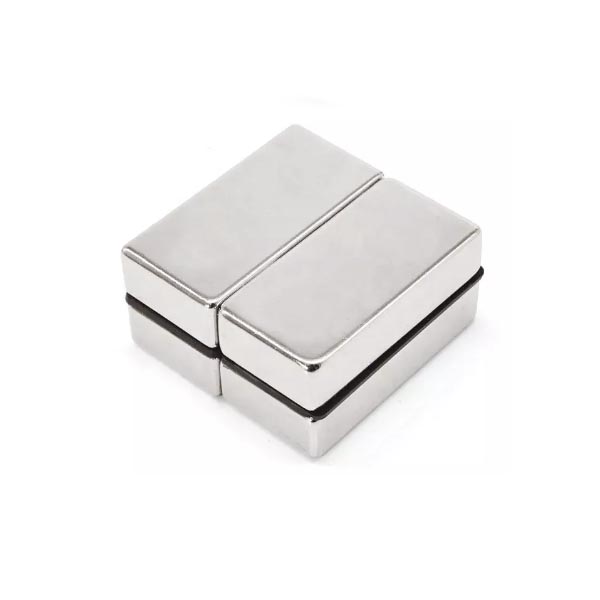
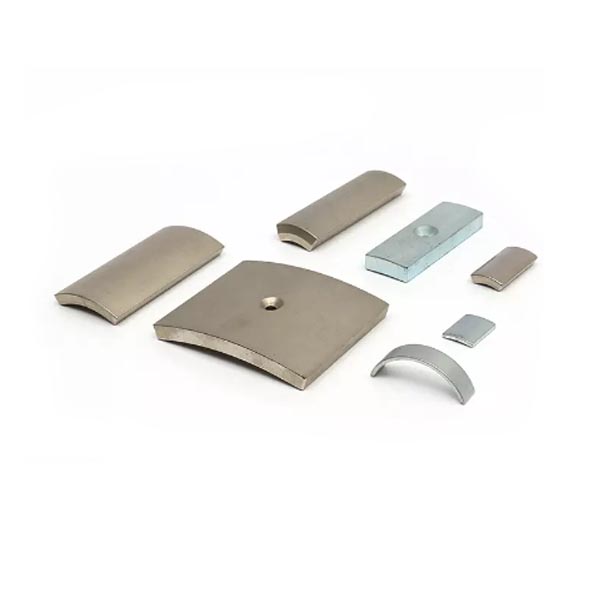
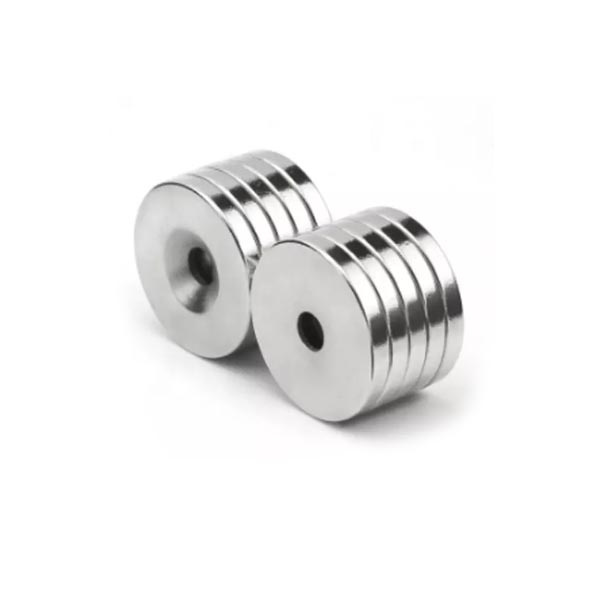
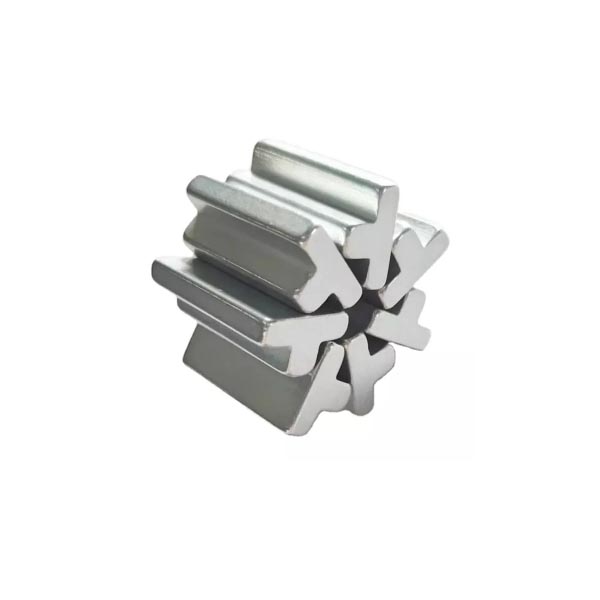
We can offer the OEM/ODM services of our products. The product can be customized according to your personalized requirements, including the size, Shape, performance, and coating. please offer your design documents or tell us your ideas and our R&D team will do the rest.
Other Types of Magnets



Post time: May-30-2026