
Cylindrical neodymium magnets are widely adopted across modern industrial fields, ranging from small electronic sensors and precision motor parts to mechanical fixtures and magnetic connection structures. While most buyers focus on outer dimensions, material grades and surface coating options, magnetization orientation is often neglected. This seemingly minor detail directly decides how a magnet interacts with surrounding metal parts and electronic components. Axial and diametrical modes are the two mainstream magnetization methods for cylindrical magnets, each carrying unique field distribution features and application boundaries. Making a clear distinction between them helps engineers reduce trial-and-error costs and improve overall product stability.
What Is Magnetization Direction?
Why Magnetization Matters in Engineering
Each permanent magnet consists of countless tiny magnetic domains, and the overall magnetic performance is determined by the unified arrangement of these micro structures. Magnetization direction refers to the overall alignment of these domains, which defines the exact location of north and south poles and the spreading range of magnetic flux. If the magnetization style fails to match the equipment operating logic, even high-grade sintered neodymium magnets cannot work normally. Common issues including insufficient adsorption force, delayed sensor response and unsmooth rotating operation are often traced back to mismatched magnetization design.
Overview of Cylinder Magnet Orientation
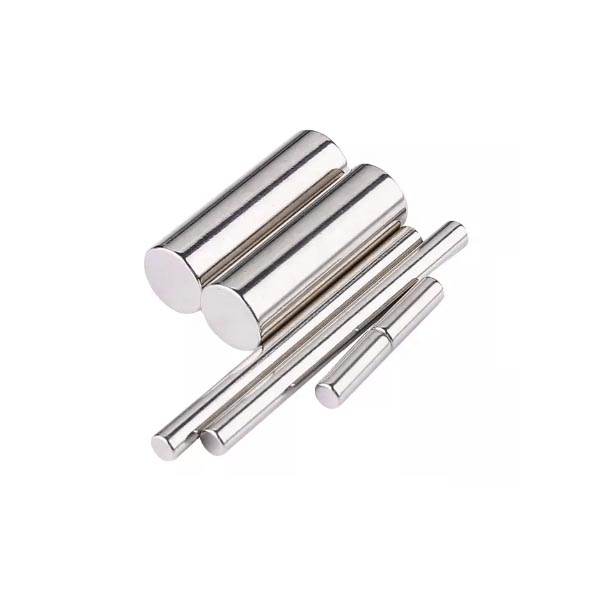
For standard round cylinder magnets used in industrial production, two mature magnetization styles dominate the market:
Axial magnetization arranges magnetic poles following the central longitudinal axis, with two opposite magnetic poles distributed on the top and bottom end faces.
Diametrical magnetization, also called radial magnetization, sets magnetic poles along the horizontal diameter, with north and south poles distributed on two opposite curved sides of the cylinder.
Each orientation is developed for specific mechanical movement modes, so rational matching with application scenarios is essential.
What Is Axial Magnetization?
Definition and Magnetic Field Direction
Under axial magnetization treatment, the internal magnetic domains of the cylinder magnet are arranged along its length direction. The upper and lower circular end faces form a pair of independent magnetic poles. Magnetic flux travels steadily between the two ends in a straight and regular path, forming a concentrated longitudinal magnetic field. This layout gathers most magnetic energy on the two end surfaces and keeps the side curved magnetic flux relatively weak.
Advantages of Axial Magnetization
This magnetization process comes with multiple practical strengths for industrial production. It delivers concentrated and stable suction on end faces, meeting most fixed clamping needs. Pole identification and on-site assembly are simple and intuitive for workshop operators. Mass production adopts standardized magnetizing equipment, which shortens delivery cycles and controls unit costs. In addition, batch magnetic consistency is easy to maintain, ensuring stable performance in long-term continuous use.
Common Applications (Holding, Sensors, Motors)
Axial magnetized cylinders are widely used in linear and contact-based working scenes. Mechanical processing jigs rely on their stable suction to fix workpieces firmly. Linear proximity sensors capture accurate signals through end magnetic field changes. Small DC motors and miniature electromagnetic components also adopt axial layout for simpler magnetic circuit design. Besides, various door lock magnetic parts and fixed positioning accessories all take advantage of this mature magnetization solution.
What Is Diametrical Magnetization?
Definition and Magnetic Field Behavior
Diametrical magnetization breaks the longitudinal pole layout and distributes north and south poles on the left and right curved sides of the cylinder. Magnetic flux stretches across the entire diameter, forming a horizontal arc-shaped magnetic field. Different from axial products, its magnetic energy mainly concentrates on the side walls, while the top and bottom end faces only retain extremely weak magnetism. This special field structure is specially designed for all kinds of rotating and lateral induction equipment.
Advantages and Limitations
This magnetization type has irreplaceable value in rotary machinery design. The lateral magnetic field can stably drive rotating parts and realize non-contact torque transmission. It fits compact internal equipment structures and effectively avoids magnetic interference along the axial direction. Even so, it still has obvious limitations. Side pole design leads to poor end suction, making it unsuitable for straight adsorption work. Custom magnetizing tools raise manufacturing difficulty and overall procurement cost, and higher requirements for installation alignment also increase assembly difficulty.
Applications (Rotary Sensors, Couplings)
Diametrical cylinder magnets are the core choice for rotary industrial components. Angular displacement encoders rely on lateral magnetic field changes to capture real-time rotation data. Non-contact magnetic couplings use their horizontal flux to transmit power and reduce mechanical wear. Brushless motor rotors and intelligent fluid monitoring sensors also widely apply this magnetization method to achieve efficient and stable operation.
Axial vs Diametrical Magnetization: Key Differences
Magnetic Field Distribution
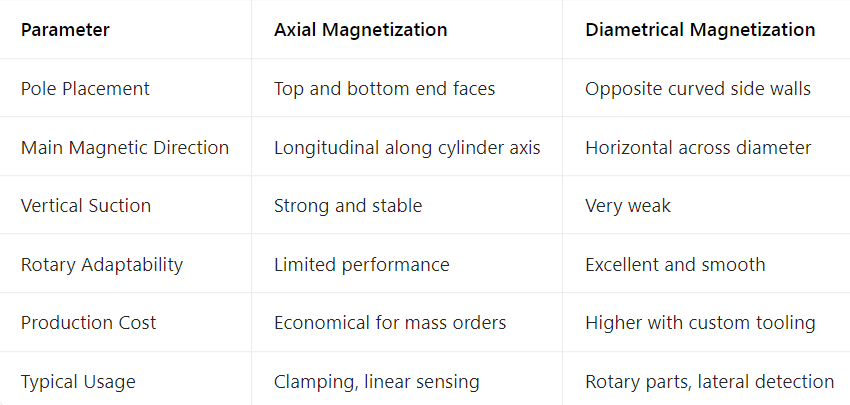
Axial magnetization gathers magnetic flux on the upper and lower circular end faces, and the magnetic field extends along the central axis in an orderly manner. By contrast, diametrical magnetization focuses effective magnetism on the curved side walls, with magnetic lines spreading horizontally across the diameter. The two field distribution modes completely adapt to different mechanical movement paths.
Pull Force vs Rotational Performance
Axial products excel in vertical pulling and fixed adsorption, with strong vertical holding force but weak rotary driving ability. Diametrical magnets cannot provide reliable end-face suction, yet their lateral magnetic interaction can output stable torque, fully meeting the operation demands of rotating structures.
Manufacturing Complexity and Cost
Axial magnetization is a fully standardized production process with universal tooling, low processing difficulty and competitive pricing for bulk orders. Diametrical magnetization needs customized magnetizing fixtures and precise pole positioning, leading to longer production cycles and higher comprehensive costs.
How to Choose the Right Magnetization Type
Based on Application Requirements
If your project needs vertical fixing, linear position detection or simple magnetic locking, axial magnetization is the most practical option. For equipment that needs to complete angle detection, rotary transmission and side signal induction, diametrical magnetization will bring better operating effects.
Based on Magnetic Field Direction
Confirm the required action direction of the magnetic field in advance. When magnetic force needs to act along the component length for matching and connection, choose axial modes. If the design requires magnetic cooperation on the horizontal side to drive rotation or induction, diametrical magnetization is the reasonable decision.
Based on Cost and Production Feasibility
For large-batch standardized parts with strict budget control, axial magnetization can balance quality and cost. For small-batch customized high-precision rotary equipment, the extra cost of diametrical magnetization is worthwhile to ensure overall product performance.
Related Magnet Solutions from Fullzen Technology
Custom Magnetization Options
Fullzen Technology delivers flexible custom magnetization solutions for all types of cylinder magnets. We cover regular 2-pole axial, standard diametrical, and special multi-pole magnetization designs. Our production team fine-tunes manufacturing processes following your drawings and technical parameters, fully meeting unique magnetic circuit and application requirements.Disc Magnets for Axial Applications
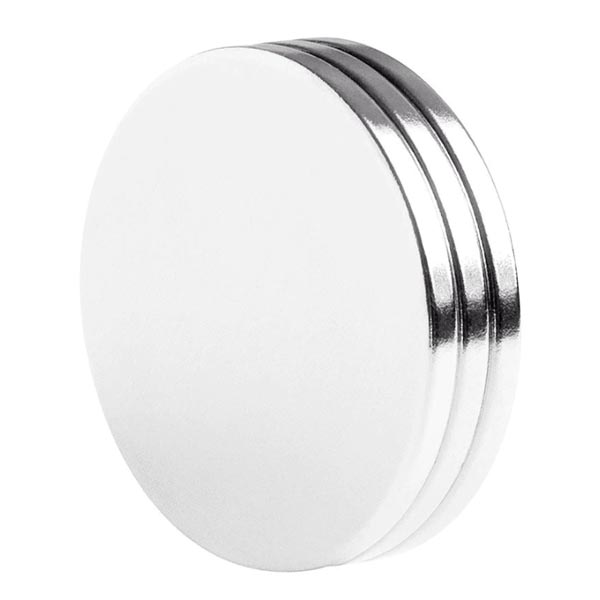
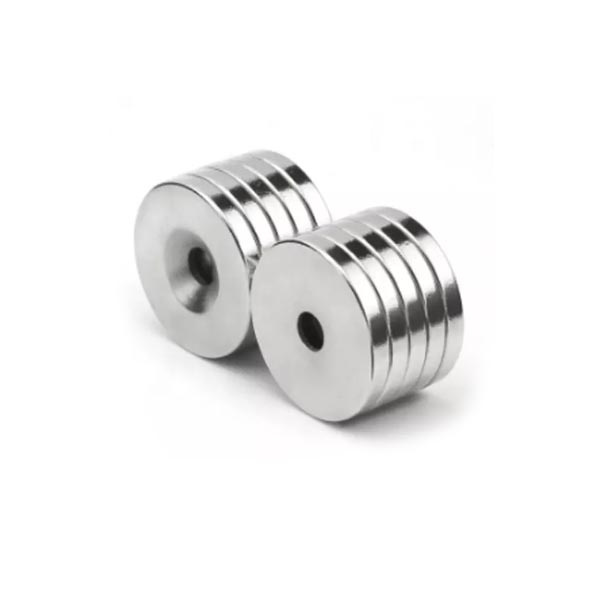
Our neodymium disc magnets adopt default axial magnetization, featuring compact size and strong end suction. They are widely used in thin equipment, hidden installation structures and various small fixed accessories, providing stable magnetic support for miniaturized product design.
Ring Magnets for Rotational Systems
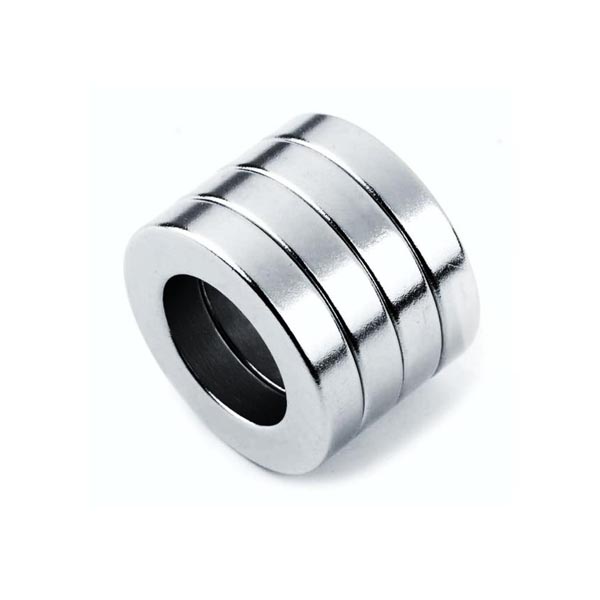
Custom neodymium ring magnets can be processed with diametrical multi-pole magnetization. They fit shaft assembly and closed magnetic circuit design, perfectly matching rotary encoders, automated motors and other high-precision rotating industrial equipment.
Conclusion
In the field of rare earth magnet application, there is no absolute distinction between good and bad for different magnetization modes. The key lies in whether it matches the actual working conditions. Axial magnetization is cost-effective and stable, ideal for linear fixation and end induction scenarios. Diametrical magnetization targets rotary mechanical design and side sensing functions, solving many structural pain points of precision equipment.
A clear understanding of magnetization differences helps designers avoid unnecessary performance defects and extra procurement costs. With rich production experience and mature custom processing capacity, Fullzen Technology continues to provide reliable magnet solutions for global industrial clients. You can contact our technical team at any time to share your project parameters, and we will recommend the most reasonable magnetization plan and high-quality cylinder magnet products for your design.
Your Custom Neodymium Magnets Project
We can offer the OEM/ODM services of our products. The product can be customized according to your personalized requirements, including the size, Shape, performance, and coating. please offer your design documents or tell us your ideas and our R&D team will do the rest.
Other Types of Magnets



Post time: Apr-29-2026