
Selecting the right rare earth magnet for harsh operating environments determines the overall service life of industrial equipment far more than size or shape adjustments. At Fullzen Technology, we’ve observed countless field failures stemming from incorrect magnet material selection, rather than dimensional errors. This practical guide breaks down the core differences between neodymium and samarium cobalt magnets, delivering clear engineering rules to help you pick the ideal option for high-temperature, corrosive, and high-reliability scenarios.
Key Quick Takeaways
- For operating temperatures below 150°C and cost-sensitive projects: Neodymium (NdFeB) magnets are the top choice
- For temperatures above 150°C or severely corrosive environments: Samarium Cobalt (SmCo) magnets deliver superior stability
- SmCo magnets feature exceptional thermal and anti-demagnetization performance but come with a higher price point
- As a professional manufacturer of both magnet types, Fullzen Technology provides data-backed, application-oriented material selection advice
As two leading types of rare earth magnets, neodymium and samarium cobalt perform quite differently when exposed to intense heat, chemical erosion and sustained operating stress. Drawing on hands-on manufacturing experience, this guide compares their key characteristics. It shares practical selection tips for aerospace, automotive systems and precision motors, letting engineers pick suitable magnets without repeated testing and balance stability with budget.
What Are Neodymium and Samarium Cobalt Magnets?
Neodymium Magnets in Brief
As the most prevalent rare earth magnet on the commercial market, NdFeB boasts extremely high magnetic energy and powerful pulling force. Made from an alloy of neodymium, iron and boron, these magnets can be fully customized in dimensions, shapes and surface finishes. They are well-suited for mass production and regular industrial use, offering great value for money.
Their biggest limitation lies in thermal stability. Standard NdFeB grades are prone to magnetic attenuation and irreversible demagnetization under prolonged high-temperature exposure. Even upgraded high-temperature NdFeB variants struggle to maintain stable performance in ultra-high-temperature or strongly corrosive working conditions, restricting their use in extreme industrial scenarios.
Samarium Cobalt Magnets in Brief
Samarium Cobalt (SmCo) magnets are premium rare earth magnetic materials composed of samarium and cobalt elements. Unlike NdFeB magnets, SmCo products excel in extreme environmental resistance, featuring ultra-high temperature tolerance, excellent anti-demagnetization capability, and natural corrosion resistance without complex surface coating treatment.
Samarium cobalt magnets have a slightly lower magnetic energy rating compared to premium neodymium products. Still, their magnetic output stays consistent through extreme heat, temperature changes and chemical contact. They cost more to produce, yet their reliable performance makes them irreplaceable for high-standard industrial projects.
Neodymium vs Samarium Cobalt: Core Differences
The following comprehensive comparison table covers all key engineering indicators, serving as the core reference for magnet material selection in high-temperature and industrial scenarios:
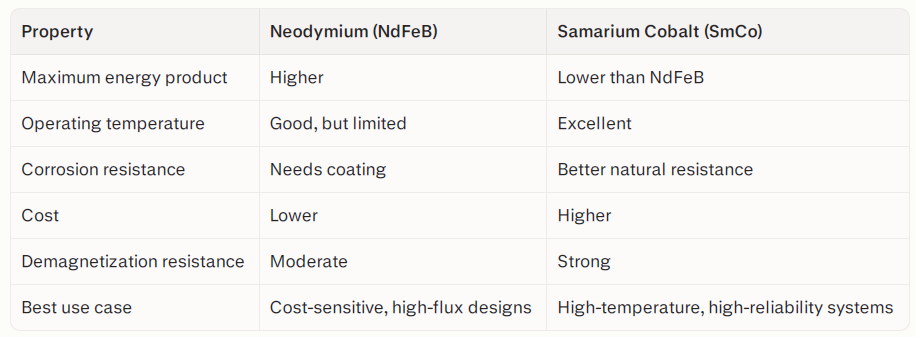
Aerospace components, automotive high-temperature parts, precision medical equipment, industrial high-temperature motors
Temperature Threshold Decision Guide
When to Choose NdFeB Magnets
Neodymium magnets are the optimal choice for most conventional industrial and commercial scenarios. If your working environment meets the following conditions, NdFeB will deliver the best balance of performance and cost:
- Steady operating temperature below 150°C with no extreme heat spikes
- Project budgets are constrained, requiring cost-effective mass production solutions
- Priority is given to high magnetic flux and strong adsorption performance within a limited space
- Working environments are dry indoor settings with low corrosion risks
When to Choose SmCo Magnets
SmCo magnets are tailored for high-demand extreme scenarios where conventional NdFeB magnets fail to sustain stable performance. Select SmCo for the following working conditions:
- Continuous operating temperature exceeds 150°C, or frequent high-temperature thermal cycling occurs
- Exposure to humid, salty, or chemically corrosive environments for a long time
- Projects require ultra-high long-term reliability, with zero tolerance for magnetic attenuation and equipment failure
- High-end equipment scenarios that prioritize stability over procurement cost
Why Temperature Is Not the Only Factor
While temperature is the primary selection benchmark, engineers cannot rely solely on heat indicators for material judgment. Multiple hidden factors affect magnet service life and stability. Frequent thermal expansion and contraction cycles will accelerate the aging of NdFeB coatings and trigger potential demagnetization. High humidity and airborne chemical contaminants will erode unprotected NdFeB substrates, even at temperatures below 150°C. Additionally, mechanical assembly stress, vibration frequency, and long-term static load will also impact magnetic performance retention. Only comprehensive environmental assessment can avoid premature magnet failure.
Performance in Real Applications
Aerospace Applications
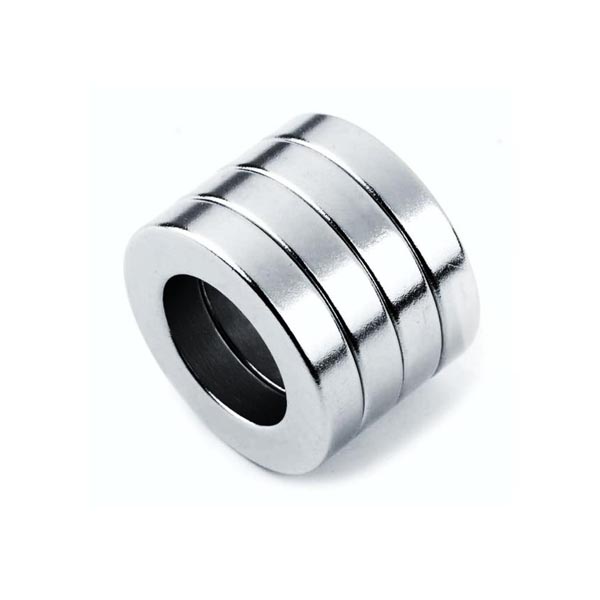
Aerospace equipment demands extreme operational stability, with components enduring drastic temperature fluctuations, high-altitude humidity, and long-term continuous operation. In this field, precision ring magnets for rotating systems and other core magnetic components must maintain consistent magnetic output without failure for years. SmCo magnets dominate aerospace applications due to their ultra-high temperature resistance, anti-demagnetization ability, and natural corrosion resistance. NdFeB magnets are rarely used here, as their limited thermal stability cannot meet aerospace-level long-term reliability standards.
Automotive Applications
Automotive magnetic components face complex working conditions, including engine bay high temperatures, road salt corrosion, and seasonal thermal cycling. For conventional indoor automotive electronic sensors and low-temperature assembly parts, high-quality coated NdFeB magnets can meet daily operational needs with cost advantages. However, for engine peripheral components, high-temperature motor parts, and chassis sensing equipment exposed to extreme heat and corrosion, SmCo magnets are the only reliable option to avoid performance degradation and component failure.
Motor Design Applications
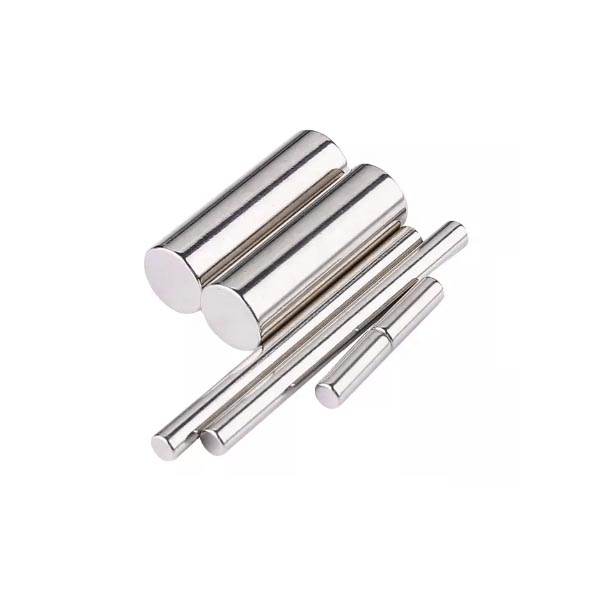
Motor design pursues high magnetic flux, high operational efficiency, and long service life. Most civilian and industrial conventional motors adopt neodymium cylinder magnets for motor assemblies, which leverage NdFeB’s high magnetic energy product to reduce motor volume and improve energy efficiency at a lower cost. Yet for high-speed, high-temperature industrial motors and special environmental drive motors, SmCo magnets outperform NdFeB significantly. They resist magnetic attenuation under high-temperature operation, ensuring stable motor output and extending the overall service life of precision motor equipment.
Manufacturing Perspective from Fullzen Technology
In our years of manufacturing and project service experience at Fullzen Technology, we have encountered a common engineering misunderstanding: most clients first ask which magnet has stronger magnetism, while the core question should be which material maintains stable performance in their specific temperature and environmental conditions. Magnetic strength is meaningless if the magnet fails prematurely in actual operation.
We manufacture both NdFeB and SmCo magnets in-house. Rather than focusing merely on individual performance figures, we create tailored custom rare earth magnet solutions around your actual working conditions. Our engineering team conducts full assessments covering heat resistance, corrosion hazards, mechanical stress and budget limits, to select the ideal magnet material, grade and surface finish for every project. Thanks to our dual production capacity, we can offer impartial technical advice that suppliers specializing in only one magnet type cannot provide.
How to Make the Right Choice
If cost matters most
When project budget control is the primary goal and working conditions are conventional indoor dry environments with temperatures below 150°C, neodymium magnets are the most cost-effective solution. With diverse grades, mature mass production processes, and optional protective coatings, they fully meet the needs of consumer electronics, ordinary automation equipment, and general assembly projects.
If heat resistance matters most
For equipment operating above 150°C or enduring frequent thermal cycling, samarium cobalt magnets are non-negotiable. Their excellent high-temperature stability and anti-demagnetization performance prevent magnetic attenuation and equipment failure caused by heat exposure, ensuring long-term stable operation of high-temperature industrial equipment.
If corrosion resistance matters most
In humid, marine, saline, or chemically corrosive environments, SmCo magnets show natural advantages. Unlike NdFeB magnets that rely on epoxy or nickel coating for protection, SmCo materials themselves are corrosion-resistant, avoiding coating peeling, substrate oxidation, and performance degradation caused by harsh environmental erosion.
Conclusion
There is a simple yet effective principle for selecting rare earth magnets. NdFeB works best for general applications with operating temperatures below 150°C and limited budgets. If your equipment faces temperatures over 150°C, chemical corrosion or strict reliability standards, samarium cobalt will be the ideal pick. Always prioritize matching material properties to on-site application demands.
Fullzen Technology integrates NdFeB and SmCo manufacturing capabilities, providing one-stop material selection, customized production, and precision processing services. We do not merely supply standard magnets but deliver targeted magnet system solutions based on your working environment, performance requirements, and long-term operational goals.
Neodymium Cylinder Magnets Manufacturer
We can offer the OEM/ODM services of our products. The product can be customized according to your personalized requirements, including the size, Shape, performance, and coating. please offer your design documents or tell us your ideas and our R&D team will do the rest.
Other Types of Magnets



Recommend Reading
Post time: May-30-2026