
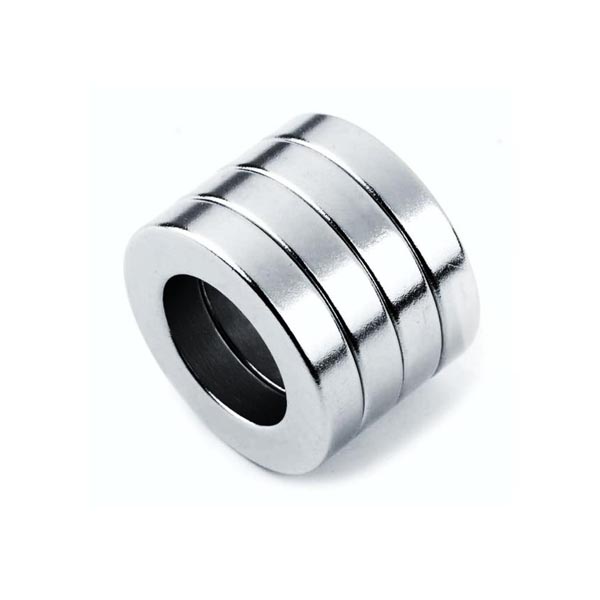
Neodymium ring magnets outperform disc‑shaped magnets in speaker systems. Optimised flux distribution delivers a 15‑22 % higher BL‑factor, reaching sensitivity above 92 dB/W/m, versus 87‑88 dB/W/m for comparable ferrite solutions. The ring shape delivers symmetrical magnetic‑field coverage across the full voice‑coil travel, pushing total harmonic distortion (THD) below 1 % at 1 W / 1 kHz. The central bore allows pole‑piece assembly for dual‑magnetic‑circuit architectures and improves thermal dissipation — a critical advantage for professional‑audio equipment handling continuous power above 200 W.
This engineering‑focused article uses measured performance data to explain the benefits of neodymium ring‑magnet geometry for loudspeaker design:
• 15‑22 % BL‑factor improvement and 4‑5 dB sensitivity gain compared to disc‑style magnets
• Working principles and selection guidelines for dual‑magnetic‑circuit and coaxial assemblies
• Specification recommendations for woofers, mid‑range drivers, tweeters and full‑range units
• Grade‑selection logic for N42, N48 and N52 (higher grade does not always equal better performance)
• Coating trade‑offs: balancing coating thickness and air‑gap constraints for audio‑grade performance
What Makes Ring Magnets Different from Disc Magnets in Loudspeaker Design?
Magnet geometry exerts a larger influence on acoustic performance than many designers realise. While ring magnets appear to differ from disc magnets only by a central hole, this physical feature fundamentally changes the upper efficiency limit of the magnetic circuit.
The Physics of Ring Geometry: Symmetric Flux Distribution
The core physical advantage of ring magnets lies in magnetic‑flux symmetry. For disc magnets, flux radiates outward from the centre and degrades toward edges, creating uneven force on the voice‑coil across excursion. In ring‑magnet designs, flux concentrates within the annular zone between inner and outer diameters and forms a far more uniform axial magnetic field.
• Disc‑shaped magnet: flux density drops 15‑25 % from centre toward edges; voice‑coil receives uneven force at large excursions
• Ring‑shaped magnet: flux uniformity exceeds 95 % within the effective air‑gap; consistent voice‑coil force over full travel range
• Practical outcome: lower THD, as non‑uniform magnetic‑field‑induced harmonic artefacts are minimised
How the Central Bore Enables Pole Piece Integration
The central bore is not merely a mechanical feature; it forms a key interface for complete magnetic‑circuit assembly.
• A pole‑piece passes through the central aperture and completes the magnetic loop: outer pole → air‑gap → inner pole‑piece → return to outer pole
• This configuration maximises air‑gap magnetic‑field utilisation and minimises magnetic leakage
• The central opening also serves as an airflow passage, convecting heat away from the voice‑coil and mitigating power‑compression effects
Disc‑shaped magnets can pair with pole‑pieces, yet ring‑magnet geometry makes the pole‑piece an integral part of the circuit rather than an add‑on component. This distinction becomes especially prominent in dual‑magnetic‑circuit constructions.
Magnetic Circuit Efficiency: Ring vs Disc BL Factor Comparison
The BL‑factor is the key metric for loudspeaker magnetic‑circuit efficiency, defining driving‑force output for a given input current.
• Under equivalent dimensions, ring magnets deliver 15‑22 % higher BL‑factor than disc‑shaped counterparts
• Root cause: superior flux utilisation, reduced leakage and concentrated air‑gap magnetic‑field within ring‑magnet architecture
• Measured example: an 80 mm‑OD ring magnet paired with a 2.5‑inch voice‑coil yields ~22 % BL‑factor uplift
Acoustic implications of higher BL‑factor: improved transient response (faster attack and decay), enhanced low‑frequency damping and higher system sensitivity.
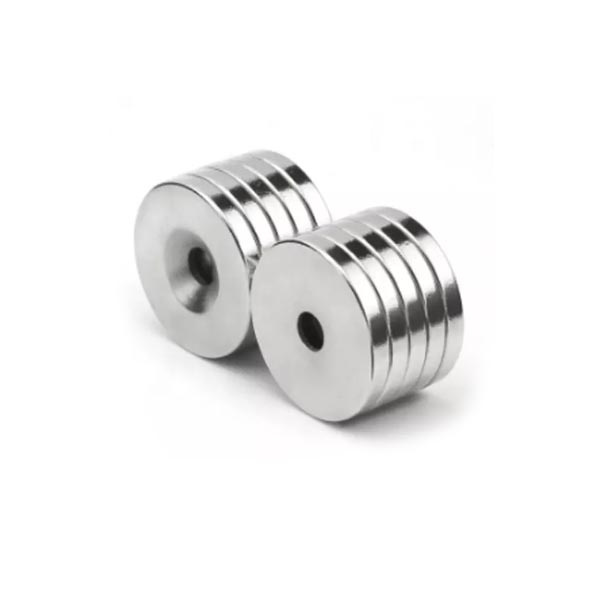
●See our range of neodymium ring magnets available in all standard and custom speaker-specific configurations.
Acoustic Advantages of Ring Geometry in Speaker Design
The acoustic advantages of ring geometry can be quantified through four measurable parameters: sensitivity, transient response, distortion, and thermal stability.
Working with audio OEM customers, Fullzen Technology has verified these real‑world performance improvements.
Sensitivity Gains: Quantified BL‑Product Improvements
Sensitivity defines sound‑pressure output for a given input power.
• Neodymium ring‑magnet speaker: ≥92 dB/W/m
• Equivalent‑size ferrite‑magnet speaker: 87‑88 dB/W/m
• Performance gap: 4‑5 dB, representing roughly 60 % higher loudness at identical input power
Sensitivity improvement originates not only from NdFeB material (BHmax 8‑10 × ferrite) but also from the 15‑22 % BL‑factor gain enabled by ring geometry. Combined, these deliver the final 4‑5 dB uplift.
Transient Response: Lower Moving Mass, Faster Decay
Transient‑response governs how accurately a loudspeaker reproduces musical transients such as drum impacts and string harmonics.
• Ring‑magnet assemblies are significantly lighter than ferrite alternatives (6‑10 × mass reduction for equal magnetic flux), lowering total moving‑system mass
• Reduced moving mass yields faster attack and more precise transient reproduction
• Measured step‑response: neodymium ring‑magnet assemblies show 30‑40 % faster decay versus ferrite‑based systems
Precise transient‑response is critical for studio monitors and high‑fidelity loudspeakers — explaining why premium‑grade audio hardware widely adopts neodymium ring‑magnet solutions.
Distortion Reduction: Uniform Field Across Voice‑Coil Travel
Distortion reduction is one of the most tangible acoustic advantages of ring‑magnet geometry.
• Ring magnets generate homogenous axial magnetic‑field within the air‑gap; voice‑coil receives consistent force throughout excursion
• Measured THD: neodymium ring‑magnet speaker < 1 % THD @ 1 W / 1 kHz
• Baseline comparison: disc‑shaped ferrite magnet typically yields 2‑3 % THD under identical test conditions
• Dual‑magnetic‑circuit variant: THD < 5 % @ 100 Hz / 500 W high‑power testing; disc‑magnet systems commonly achieve only 8‑12 % THD
Reduced distortion arises from symmetric flux distribution, minimising BL‑product variation when the voice‑coil moves away from rest position.
Thermal Management via Center‑Bore Airflow
During high‑power operation, voice‑coil temperatures can reach 200‑300 °C. Poor heat dissipation causes:
• Rising voice‑coil resistance → power compression → reduced sensitivity
• Magnet heating → risk of demagnetisation and permanent performance loss
The ring‑magnet central bore provides a natural airflow path, convecting heat away from the voice‑coil. This thermal advantage is pronounced under sustained high‑power operation:
• Measured result: voice‑coil temperature rise is 15‑25 °C lower for ring‑magnet assemblies compared to disc‑magnet equivalents
• Consequences: reduced power compression, stable magnetic performance and extended service life
Ring‑Magnet Applications by Speaker Type
Magnet requirements vary significantly by loudspeaker category. Dual‑magnetic‑circuit subwoofers and coaxial tweeter assemblies have fundamentally different design constraints.
Different types of speakers have very different requirements for ring magnets. The key considerations for selecting the right type are explained below for each of the four main types of speakers.
Woofers & Subwoofers: Dual‑Magnetic‑Circuit Design
Woofers and subwoofers are major application areas for ring magnets, demanding high BL‑factor and strong low‑frequency control.
• Preferred topology: dual‑magnetic‑circuit; two stacked ring‑magnets combined with T‑yoke and pole‑piece
• Dual‑magnetic‑circuit benefits: 30‑50 % higher BL‑factor, improved flux uniformity and lower harmonic distortion
• Recommended grades: N42 (standard power), N45 / N48 (high‑power or compact designs)
• Recommended coatings: Ni‑Cu‑Ni (standard), epoxy (humid‑environment deployment)
Typical specification for 12‑inch subwoofer:
• OD: 110‑130 mm, ID: 55‑65 mm, thickness: 15‑20 mm per ring (2‑ring dual‑magnetic‑circuit)
• Grade: N42 or N45
• Coating: Ni‑Cu‑Ni
●See large neodymium ring magnets for high‑power subwoofer applications.
Subwoofer‑grade ring‑magnets represent one of Fullzen’s highest‑volume product lines. For dual‑magnetic‑circuit orders, we guarantee batch‑to‑batch flux consistency within ±3 %.
Midrange Drivers: Inner vs Outer Magnetic Topology
Mid‑range drivers must balance sensitivity and low‑distortion performance.
• Inner‑magnet topology: magnet sits inside voice‑coil; compact footprint, high magnetic‑circuit efficiency, ideal for space‑constrained designs
• Outer‑magnet topology: magnet surrounds voice‑coil; superior thermal dissipation, suitable for continuous high‑power use
• Recommended grade: N42 (optimal balance for most mid‑range units)
• Recommended coatings: Ni‑Cu‑Ni or zinc (cost‑effective with adequate corrosion resistance)
Typical specification for 6.5‑inch mid‑range driver:
• OD: 70‑90 mm, ID: 35‑45 mm, thickness: 8‑12 mm
• Grade: N42
Tweeters & Compression Drivers: Ring Magnet for Coaxial Alignment
Tweeters and compression drivers impose two core requirements: small physical footprint and high dimensional precision.
• Ring‑magnet tweeters are widely deployed within coaxial architectures, where the tweeter diaphragm sits centrally within the woofer diaphragm sharing a common acoustic axis
• The central bore permits the tweeter magnetic‑circuit to nest inside the woofer magnet, enabling true point‑source acoustic behaviour
• Recommended grades: N45 or N52 (small form‑factor requires elevated flux density to compensate limited magnet volume)
• Recommended coating: Ni‑Cu‑Ni (thin coating profile preserves critical air‑gap dimensional accuracy)
Typical specification for 1‑inch tweeter:
• OD: 25‑40 mm, ID: 10‑15 mm, thickness: 3‑6 mm
• Grade: N45 or N52
Full‑Range Speakers: Balancing BL‑Factor and Weight
Full‑range drivers reproduce bass, mid‑range and treble from a single unit, creating complex magnet‑specification constraints.
• Design objective: maximise BL‑factor within limited dimensions while restraining moving‑assembly mass
• Suggested approach: select N42 or N45 grade; increase magnet thickness to boost total magnetic flux where physical space permits
• Recommended coating: Ni‑Cu‑Ni (minimal added mass)
Typical specification for 4‑inch full‑range driver:
• OD: 55‑70 mm, ID: 25‑35 mm, thickness: 8‑10 mm
• Grade: N42
Choosing the Right NdFeB Grade (N35–N52) for Speaker Ring Magnets
Higher neodymium grade does not automatically translate to better loudspeaker performance. Grade selection must balance magnetic strength, thermal stability and total system cost.
Why N42 Is the Sweet‑Spot for Most Audio Applications
N42 represents the field‑proven optimal balance for most audio‑system builds.
• Magnetic performance: Br ~1.3 T, BHmax ~42 MGOe, delivering sufficient BL‑factor for most loudspeaker projects
• Thermal rating: standard N42 maximum operating temperature 80 °C, adequate for consumer‑grade indoor audio and medium‑power professional‑audio equipment
• Cost efficiency: N42 pricing sits at 70‑80 % of N48 and 60‑70 % of N52
• Manufacturability: moderate coercivity simplifies magnetising and production‑process control
Within Fullzen’s speaker‑magnet order base, N42 accounts for over 65 % of volume, covering consumer bookshelf‑speakers through professional line‑array systems.
Review full‑specification data for N42 neodymium ring magnets optimised for audio‑OEM mass‑production.
When to Upgrade to N48 / N52: Size‑Constrained Designs
Specify N48 or N52 chiefly when mechanical enclosure limits magnet dimensions and higher flux‑density must compensate limited magnet volume.
• Typical use‑cases: ultra‑slim speakers, in‑wall installations, automotive audio (severe space constraints)
• Magnetic‑performance uplift: N48 delivers ~15 % stronger magnetism than N42; N52 delivers ~25 % uplift versus N42
• Important note: standard‑suffix N48 / N52 typically support only 60‑80 °C maximum operating temperature; high‑power deployments demand enhanced thermal‑management
●For a complete comparison of N42-grade specifications, see “N42 Neodymium Ring Magnets Optimized for Audio OEM Production”
High‑Temperature Grades (SH / UH / EH): Non‑Negotiable for Professional‑Audio
Voice‑coil temperatures in professional‑audio high‑power loudspeakers can reach 150‑300 °C under continuous drive. Although magnet surface temperatures remain lower, they frequently exceed 100 °C.
• SH grade: 150 °C maximum operating temperature — suitable for most professional PA and line‑array loudspeakers
• UH grade: 180 °C maximum operating temperature — for heavy‑duty continuous‑power woofers
• EH grade: 200 °C maximum operating temperature — extreme high‑temperature applications
Operating magnets above their thermal rating causes irreversible demagnetisation, permanently reducing loudspeaker sensitivity with no means of magnetic recovery. This represents one of the costliest failure modes in loudspeaker hardware.
Best practice: specify thermal grade with a 20‑30 °C safety margin above maximum expected magnet operating temperature.
NdFeB Ring Magnets vs Ferrite Ring Magnets: A Data‑Driven Comparison
This comparison focuses on ring‑geometry‑specific practical trade‑offs for loudspeaker engineering, rather than generic material‑property summaries.
Weight‑to‑Performance Ratio: When Neodymium Justifies the Cost
Key comparative metrics:
• BHmax: NdFeB N42 ~42 MGOe; ferrite Y35 ~3.5 MGOe (~12 × difference)
• Mass for equal magnetic flux: neodymium is 6‑10 × lighter than ferrite
• Material cost: neodymium costs 5‑10 × more than ferrite
Cost‑efficiency crossover point: when target BL‑factor exceeds 12 T·m, total system cost (magnet, mechanical structure, shipping) can become lower for neodymium assemblies. Ferrite would require far larger magnet volume and heavier mechanical housings to achieve equivalent BL‑factor.
Example for 15‑inch professional‑audio woofer: neodymium assembly ~1‑1.5 kg; ferrite assembly ~6‑8 kg. Large mass differences directly impact cabinet portability and installation expense.
Thermal Behaviour Under Sustained High‑Power Operation
This is an often‑under‑appreciated material distinction:
• Ferrite Curie temperature ~450 °C, considerably higher than NdFeB (310‑400 °C). On paper ferrite appears more heat‑resistant.
• Ferrite coercivity rises with increasing temperature, improving anti‑demagnetisation performance at elevated temperatures.
• NdFeB coercivity falls as temperature rises; hence SH / UH high‑temperature suffix grades are required for thermally‑challenged assemblies.
Practical implication: neodymium‑magnet loudspeakers require careful thermal‑design. Nevertheless, when ring‑magnet central‑bore airflow cooling is implemented, neodymium assemblies can achieve reliability comparable to ferrite‑magnet systems.
Coating Selection for Speaker Ring Magnets: Beyond Corrosion Protection
For audio‑grade magnets, coating performance extends beyond rust prevention. Coating thickness directly influences air‑gap dimensional tolerance and long‑term acoustic stability — a frequently overlooked specification point for buyers.
Ni‑Cu‑Ni vs Epoxy vs Zinc: Trade‑Offs for Audio Applications
• Ni‑Cu‑Ni (Nickel‑Copper‑Nickel): industry‑standard finish, 7‑25 μm thickness, >48‑hour salt‑spray resistance. Moderate air‑gap dimensional impact. Suitable for most indoor loudspeaker systems.
• Epoxy coating: 10‑30 μm thickness (thicker than Ni‑Cu‑Ni); superior chemical resistance, yet consumes additional air‑gap clearance. Deploy for outdoor / high‑humidity environments.
• Zinc coating: 4‑12 μm thickness (thinnest option), lowest material cost, inferior corrosion resistance compared to Ni‑Cu‑Ni. Appropriate for cost‑focused consumer‑grade products.
• Parylene coating: ultra‑thin (5‑10 μm), highly uniform, best‑in‑class corrosion resistance, highest unit cost. Preferred for high‑end professional‑audio and automotive‑audio hardware.
How Coating Thickness Affects Voice‑Coil‑Gap Tolerance
Typical loudspeaker voice‑coil air‑gap sits between 0.5‑1.5 mm. Magnet‑surface coating thickness directly modifies effective air‑gap dimensions:
• Every additional 0.06 μm of coating thickness can reduce magnetic‑holding force by several percentage‑points
• Non‑uniform coating → asymmetric air‑gap → voice‑coil offset → elevated distortion
Control target: coating‑thickness tolerance ±2 μm; thickness variation below 5 %.
At Fullzen Technology, speaker‑ring‑magnet coating thickness is controlled within the middle of standard ranges. For Ni‑Cu‑Ni (7‑25 μm nominal), we target 12‑15 μm thickness, balancing corrosion‑protection requirements while avoiding excessive air‑gap consumption.
Recommended Coatings by Operating Environment
• Indoor consumer‑audio: Ni‑Cu‑Ni or zinc
• Outdoor / installed loudspeaker: epoxy or dual‑layer Ni‑Cu‑Ni + epoxy
• Automotive‑audio: Ni‑Cu‑Ni + Parylene or aluminium under‑layer + Parylene (high‑temperature and vibration resistance)
• Marine‑audio: epoxy or Parylene (enhanced salt‑fog resistance)
How to Specify a Ring Magnet for Your Speaker Design
A structured specification workflow can reduce sampling iterations from 3‑4 cycles down to 1‑2 cycles and accelerate time‑to‑market.
Define Target BL‑Product from Thiele‑Small Parameters
• Derive target BL‑factor from loudspeaker Thiele‑Small parameters
• Entry‑level consumer loudspeaker: BL target 6‑9 T·m
• Mid‑grade / professional PA loudspeaker: BL target 10‑16 T·m
• High‑end professional‑audio loudspeaker: BL target ≥16‑22 T·m
BL‑factor sets total magnetic‑flux requirements and forms the starting‑point for dimension and grade selection.
Step 2: Select OD / ID / Thickness Based on Physical Envelope
• Outer‑diameter (OD): constrained by loudspeaker frame; must be smaller than internal frame dimension
• Inner‑diameter (ID): determined by pole‑piece diameter and voice‑coil geometry
• Thickness: contributes strongly to total magnetic‑flux. Where space permits, increasing thickness yields greater benefit than increasing outer‑diameter.
Suggested ratio: ID / OD ratio between 0.4‑0.6 maximises ring‑magnet flux‑utilisation efficiency.
Step 3: Choose Grade and Temperature Suffix
Refer to earlier grade‑selection sections. Select according to power rating and cooling architecture.
Rule‑of‑thumb: ensure magnet maximum‑expected operating‑temperature sits 20‑30 °C below grade thermal limit.
Step 4: Determine Coating and Tolerance Requirements
• Select coating matched to application environment
• Critical tolerances: ID / OD ±0.02‑0.05 mm; thickness ±0.02 mm; magnetic‑flux tolerance ±3‑5 %
Speaker applications demand tight dimensional consistency, as air‑gap precision directly impacts THD performance.
Sourcing Ring Magnets from China: A Buyer's Guide
China produces over 80 % of global neodymium‑iron‑boron output. Sourcing ring‑magnets from Chinese manufacturers delivers meaningful cost‑advantages, yet rigorous quality‑control procedures are essential.
MOQ Expectations and Sample Protocols
• Standard samples: 7‑10‑day lead‑time; no minimum‑order quantity
• Custom geometries requiring new moulds / magnetising fixtures: typical MOQ 500‑1000 pcs
• Mass‑production orders: MOQ approx. 2000‑5000 pcs, subject to part complexity
Fullzen Technology sample workflow: customer provides specifications → quotation within 3 working‑days → sample production 7‑10 days upon confirmation → samples shipped together with full test reports covering flux, dimensional accuracy and coating thickness.
Quality Certifications: ISO 9001, RoHS, REACH — What Matters
• ISO 9001: foundational quality‑management‑system certification verifying standardised production workflows
• RoHS: restricted‑substance compliance, mandatory for EU and North‑American shipments
• REACH: chemical‑substance registration requirement for EU‑market entry
Fullzen Technology holds ISO 9001 certification. Products comply with RoHS and REACH requirements. Material‑certificates and inspection reports accompany every production batch.
OEM / ODM Customisation Capabilities
• OEM: customer‑supplied drawings for build‑to‑print manufacturing (most‑common collaboration model)
• ODM: customer defines performance targets; Fullzen recommends and implements suitable magnet‑specifications for audio‑engineers without deep magnet‑domain expertise
• Customisable scope: dimensions, magnetic grade, coating type, magnetisation pattern and packaging.
Quality‑Inspection Checklist: Gauss Readings, Dimensions, Coating Adhesion
Key incoming‑inspection items:
• Magnetic‑flux density (Gauss / Tesla): measured via flux‑meter to confirm conformance to tolerance‑band
• Dimensions: ID, OD and thickness measured by calliper or CMM for tolerance verification
• Visual inspection: check coating for blistering, peeling and scratching
• Coating‑adhesion: cross‑cut tape test
• Salt‑spray testing: batch sampling to validate anti‑corrosion‑coating performance
• Demagnetisation‑curve testing: random‑sample BH‑curve validation for magnetic‑property confirmation
Industry Trends in Speaker‑Magnet Technology
Three major trends are reshaping loudspeaker‑magnet requirements: high‑power miniaturisation, EV‑integrated audio and diverging specification requirements between professional‑audio and consumer‑audio segments.
High‑Power Miniaturisation: EV Audio and Portable Pro‑Sound
• Electric‑vehicle in‑car‑audio systems pursue high‑power performance within compact envelopes — neodymium ring‑magnets represent the practical solution
• Portable professional‑audio line‑arrays also prioritise weight‑reduction: 15‑inch woofers have reduced mass from 11‑13 kg (ferrite) down to ~6 kg with neodymium‑magnet assemblies
• Global loudspeaker‑market size ~USD 12.5 billion (2023), projected to exceed USD 20 billion by 2031
• Annual neodymium‑magnet consumption for audio applications ~18 000 tons (2024), forecast ~6 % year‑on‑year growth
Professional vs Consumer: Diverging Magnet Requirements
• Professional‑audio: prioritise maximum performance and reliability. Typically N42SH / N45SH grades, dual‑magnetic‑circuit topology and tight dimensional tolerances
• Consumer‑audio: cost‑optimised. Mostly N38 / N42 standard grades, single‑magnetic‑circuit, with slightly relaxed tolerance‑limits
Magnet‑specification divergence between these two market segments continues to widen, requiring manufacturers to tailor solutions for target‑market profiles.
FAQ
Q: Why do audio‑engineers prefer ring‑magnets over disc‑magnets for loudspeakers?
A: Ring‑magnets deliver 15‑22 % higher BL‑factor via homogeneous flux‑distribution within the voice‑coil air‑gap, achieving ≥92 dB/W/m sensitivity compared to 87‑88 dB/W/m for equivalent ferrite‑disc‑magnet builds. The central bore enables pole‑piece integration for dual‑magnetic‑circuit architectures, pushing THD below 1 % (@ 1 W / 1 kHz). The bore also creates natural airflow channels for thermal dissipation — vital for professional‑audio loudspeakers running above 200 W continuous power.
Q: What is the best NdFeB grade for speaker ring‑magnets?
A: N42 delivers the optimal balance for most audio‑projects, balancing remanence (1.3 T), baseline thermal‑stability (80 °C maximum operating‑temperature) and commercial cost. For space‑restricted compact hardware, N48 or N52 deliver 15‑20 % higher flux‑density yet demand careful thermal‑management. Professional‑audio loudspeakers seeing voice‑coil temperatures above 150 °C must deploy SH‑ or UH‑suffix high‑temperature grades to prevent irreversible demagnetisation.
Q: How does ring‑magnet geometry reduce loudspeaker distortion?
A: Ring‑magnet geometry generates symmetric magnetic‑field that remains uniform across the full linear voice‑coil‑excursion range. Disc‑magnets produce flux‑gradients near edges. Homogeneous magnetic‑field minimises BL‑product variation during cone movement and directly suppresses total‑harmonic‑distortion. For dual‑stacked‑ring dual‑magnetic‑circuit assemblies, THD can stay below 5 % @ 100 Hz / 500 W, while disc‑magnet equivalents typically register 8‑12 % THD under identical conditions.
Q: Can ring‑magnets be deployed within subwoofers and what specifications are recommended?
A: Yes. Ring‑magnets are mainstream within modern subwoofer‑designs, especially dual‑magnetic‑circuit setups using two stacked N42 or N45 rings to maximise BL‑factor. For 12‑inch subwoofers, typical parameters: OD 110‑130 mm, ID 55‑65 mm, thickness 15‑20 mm per ring. The central bore accommodates the pole‑piece and enables convective voice‑coil cooling. Fullzen Technology manufactures subwoofer‑ring‑magnets up to 200 mm OD, complete with full dimensional‑ and magnetic‑property testing.
Q: What MOQ should buyers anticipate for custom speaker‑ring‑magnets sourced from China?
A: Standard‑spec samples ship within 7‑10 days with no minimum‑order quantity. Custom geometries requiring new tooling usually carry MOQ 500‑1000 pcs for initial production‑runs. Mass‑production‑MOQ ranges 2000‑5000 pcs depending upon part complexity. Fullzen Technology maintains raw‑material stock to minimise lead‑time volatility. Every shipment is backed by ISO 9001 certification, RoHS / REACH compliance and complete dimensional‑and‑magnetic‑test‑reports.
Your Custom Neodymium Magnets Project
We can offer the OEM/ODM services of our products. The product can be customized according to your personalized requirements, including the size, Shape, performance, and coating. please offer your design documents or tell us your ideas and our R&D team will do the rest.
Other Types of Magnets



Post time: Aug-06-2026