
Neodymium ring magnets are sized by three dimensions: outer diameter (OD), inner diameter (ID), and thickness. Standard OD ranges from 4mm to 100mm+, ID from 2mm to 50mm+, and thickness from 1mm to 30mm. At Fullzen Technology, we produce ring magnets in all standard sizes and custom dimensions with ±0.05mm tolerance — from small 4×2×2mm instrumentation rings to large 100×50×25mm motor assemblies. Pull force depends on all three dimensions and grade, not OD alone.
This guide is compiled by Fullzen Technology based on actual production data, covering:
- Standard size system (OD 4mm–100mm+ / ID 2mm–50mm+ / Thickness 1mm–30mm)
- Pull force ranges, common applications, and tolerance requirements across different size segments
- The real impact of dimensional changes on magnetic force (non-linear relationship, requires comprehensive calculation)
- Engineering feasibility criteria for custom sizes
- A 5-step selection decision path to help you quickly lock in the right specifications
Whether you're specifying dimensions for the first time for a prototype or adjusting an existing design — this guide helps reduce back-and-forth communication.
How Ring Magnet Dimensions Work: OD, ID & Thickness
Ring magnets are defined by three dimensions. Understanding how each one affects magnetic performance is the foundation of correct specification.
On every ring magnet we ship, the spec sheet shows three numbers: Outer Diameter (OD) × Inner Diameter (ID) × Thickness (T). For example, 20×10×5mm means 20mm outer diameter, 10mm center hole, and 5mm thickness.
Many procurement professionals ask during their first inquiry: "Does a larger OD mean stronger magnetic force?" The answer is — not entirely. The magnetic force of a ring magnet is determined by all three dimensions working together. Changing any one dimension alters the magnetic circuit structure.
Outer Diameter (OD)
Outer diameter determines the total magnetic pole area. A larger OD provides more material area for magnetization, theoretically allowing for a higher magnetic force ceiling. However, increasing OD also increases weight and cost proportionally, and the actual pull force is also constrained by ID and thickness.
- Standard OD range: 4mm – 100mm (4mm–30mm are most commonly used)
- ODs beyond 100mm are feasible, but we typically recommend segmented assembly or multi-pole magnetization designs
- OD tolerance: Standard ±0.05mm, precision requirements can achieve ±0.03mm
Inner Diameter (ID)
The inner diameter is the defining feature that distinguishes ring magnets from disc magnets. The ID size directly affects the effective area of the magnetic pole face — the larger the ID, the smaller the actual magnetic pole area, and the lower the magnetic force.
ID design is usually driven by assembly requirements: shaft feed-through, wiring passage, or structural fastening. That's why ID is often the "fixed" dimension, with OD and thickness adjusted afterward to compensate for magnetic force.
- Standard ID range: 2mm – 50mm
- Recommended ID/OD ratio: 0.3–0.7. Exceeding this range leads to significant magnetic force reduction
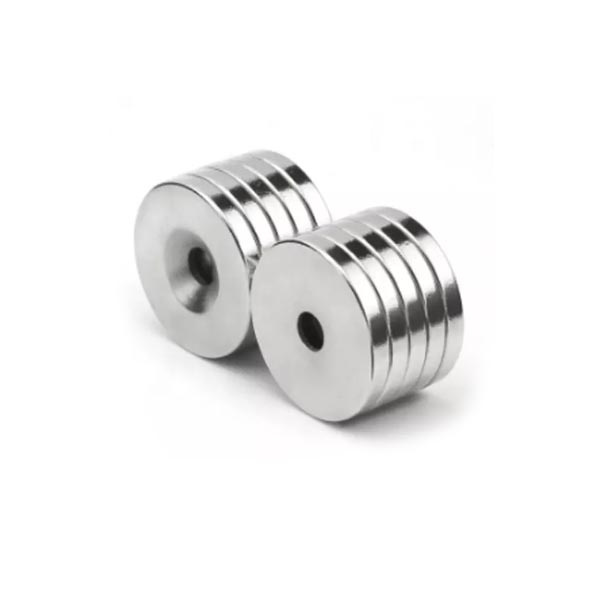
- Countersunk ring magnets have special angular designs in the ID area that require separate confirmation
Thickness
Thickness has a more significant impact on magnetic force than most procurement professionals expect. Increasing thickness directly boosts magnetic flux, but there is a saturation point — beyond a certain thickness, magnetic force growth levels off while cost and weight continue to rise.
- Standard thickness range: 1mm – 30mm
- Thin (1–3mm): Suitable for sensors and precision instruments
- Medium (4–10mm): The most commonly used range, covering motors, holding, separation, and other mainstream applications
- Thick (10mm+): Large motors, magnetic separation equipment, industrial fixtures
Fullzen Technology can produce precision ring magnets with thickness tolerance of ±0.03mm, suitable for motor and sensor applications with strict assembly clearance requirements.
Complete Neodymium Ring Magnet Size Chart
Below is a three-dimensional reference covering size, pull force, and typical applications — the kind of chart most supplier sites don't provide.
The following data is based on actual test ranges for N35-N52 grades. Specific pull force depends on grade, dimensional combination, and test conditions. We've compiled this table to help you quickly assess: what magnitude your target size falls into, and whether customization is needed.
Small Ring Magnets (OD 4mm – 20mm)
Target keywords: small neodymium ring magnets, 6mm ring magnet, 8mm ring magnet, 10mm ring magnet, 12mm ring magnet, 15mm ring magnet, 20mm ring magnet
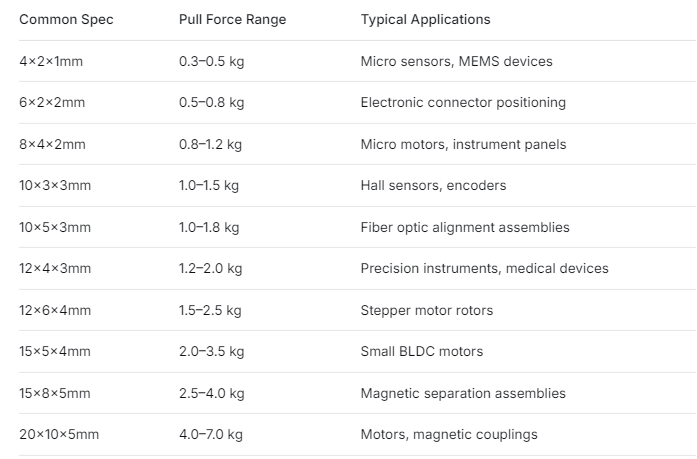
- Small ring magnets typically require tighter tolerances (±0.03–0.05mm) due to smaller assembly clearances
- This size range is one of Fullzen Technology's highest-volume categories, with monthly production capacity exceeding 800,000 units
- For requirements beyond standard specifications, refer to our custom neodymium ring magnets capabilities
Medium Ring Magnets (OD 20mm – 50mm)
Target keywords: neodymium magnet ring 50mm, 25mm ring magnet, 30mm ring magnet, 38mm ring magnet, 40mm ring magnet, 1 inch ring magnet
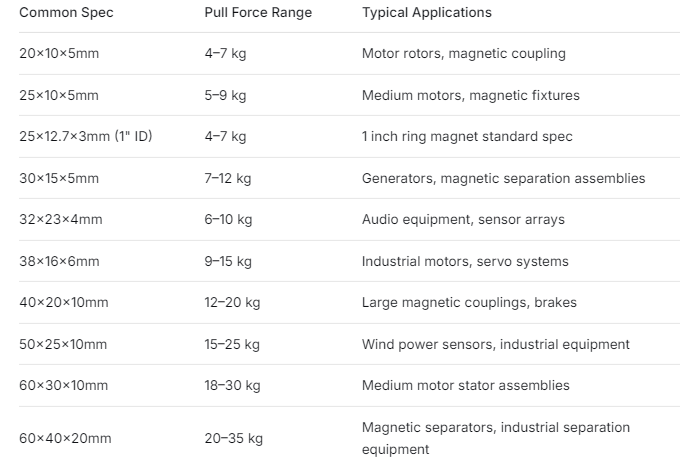
- This size range is the most concentrated in industrial applications, with motor and generator customers accounting for over 60%
- 25×12.7×3mm is a commonly used 1-inch ID specification in the North American market — we have tooling in stock
- For higher-performance medium-size magnets, see the pull force performance of N42 neodymium ring magnets
Large Ring Magnets (OD 50mm – 100mm+)
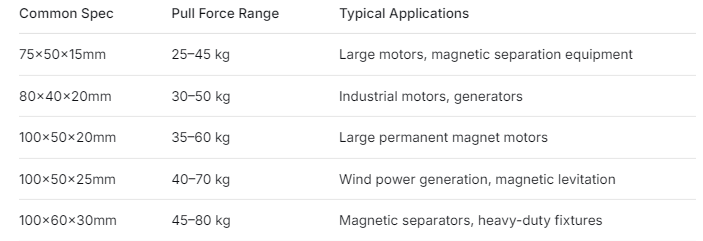
- Magnetization uniformity control for large ring magnets is a key technical challenge — Fullzen Technology uses multi-stage magnetization processes to ensure magnetic field consistency
- For ring magnets beyond 100mm OD, we typically recommend magnetic circuit simulation before finalizing dimensions
- For detailed specifications and customization processes for large sizes, refer to the large neodymium ring magnets product page
Large ring magnets typically require 5–7 working days longer lead time than standard parts due to the need for dedicated tooling and magnetization fixture calibration. For batch orders, we recommend placing orders 4–6 weeks in advance.
How Size Affects Pull Force: What Actually Matters
Size and pull force don't follow a simple linear relationship. Here's what the numbers actually mean for your application.
Many procurement professionals ask directly: "How many kilograms can a 20×10×5mm magnet hold?" There's no single answer, because pull force depends on the combination of all three dimensions, material grade, and test conditions.
Key Factors That Determine Pull Force
- Magnetic pole area = π/4 × (OD² − ID²): This is the most fundamental calculation starting point. The larger the OD and the smaller the ID, the greater the effective area
- Thickness and magnetization direction: Thickness direction is the magnetization direction. Increasing thickness can increase magnetic flux, but growth levels off beyond saturation thickness
- Material grade: For the same dimensions, N52 delivers approximately 40–50% higher pull force than N35
- Test conditions: Standard pull force testing is conducted against a flat mild steel surface. In actual applications, air gap, surface roughness, and temperature all affect actual pull force
Common Misconceptions
We've encountered several common dimensional misconceptions in our daily business:
- Myth 1: Larger OD means stronger pull force → If ID increases proportionally, the magnetic pole area may actually shrink, reducing pull force
- Myth 2: Thicker is always better → Beyond saturation thickness, magnetic force increases minimally while cost and weight continue to rise
- Myth 3: Reverse-engineering size from pull force → Pull force is only a reference value; actual operating conditions (air gap/temperature/vibration) require derating
- Myth 4: Ring magnets and disc magnets of the same size have the same pull force → Ring magnets have a center hole, resulting in smaller magnetic pole area, so pull force is lower than disc magnets of the same size
If you have a specific target pull force, our engineering team can work backward from your ID constraint and application conditions to calculate the optimal OD and thickness combination, providing 2–3 viable options.
Size Selection by Application
Different industries have distinct size requirements. Here's what we see across real orders at Fullzen Technology.
Motors & Generators
- Typical OD range: 15mm – 80mm
- ID is typically determined by rotor/stator shaft diameter — a fixed value
- Thickness is determined by magnetic circuit design, typically 5–15mm
- Grade selection: N42–N48 for BLDC motors, N45–N52 for servo motors
- Key requirements: Magnetization uniformity, dynamic balance compatibility, temperature resistance
- For complete motor-specific ring magnet parameters, see ring magnets for motors & generators
Sensors & Instrumentation
- Typical OD range: 4mm – 20mm
- Tolerance requirements: Strict, typically ±0.03mm
- Thickness: Generally thin, mostly 1–5mm
- Grade selection: N35–N42 is sufficient — highest grade not required
- Key requirements: Dimensional consistency, batch-to-batch stability
Magnetic Separation
- Typical OD range: 30mm – 100mm+
- Thickness: Generally thick, 10–30mm
- Grade selection: N35–N42 (cost-effectiveness priority)
- Key requirements: Corrosion-resistant coating (due to potential liquid contact), cost control at high volumes
Magnetic Coupling & Holding
- Typical OD range: 20mm – 60mm
- ID is determined by shaft feed-through requirements
- Thickness: Medium, 5–15mm
- Grade selection: Based on target torque/pull force requirements, N35–N52
- Key requirements: Magnetic force consistency between paired magnets
Custom vs. Standard Sizes: When to Go Custom
Standard sizes save time and cost, but custom dimensions are often necessary for optimized designs.
When Standard Sizes Work
- Your ID/OD/thickness combination is already covered in the size tables above
- No extreme pull force requirements — standard grade is sufficient
- Lead time is critical — need fast samples (standard parts: 3–5 days for samples)
- Browse our full range of neodymium ring magnets standard specifications
When Custom Sizes Make Sense
- Your design has special ID/OD ratio requirements that standard parts can't meet for magnetic force targets
- Assembly space is constrained, requiring non-standard dimensions
- Operation in specific temperature/environment conditions requires material formulation adjustment
- Volume is large enough (typically 500+ pieces) that custom tooling cost per unit is acceptable
Fullzen Technology supports full-size customization with a minimum order quantity of 100 pieces. Customization process: drawing confirmation → magnetic circuit simulation → prototyping → pilot run validation → mass production. From drawing to first sample typically takes 7–10 working days.
Tolerance Standards for Ring Magnets
Tolerance directly affects assembly fit and magnetic circuit performance.
Tolerance control for ring magnets is key to ensuring batch consistency. Different applications have vastly different tolerance requirements:
- Standard tolerance: ±0.05mm (covers most industrial applications)
- Precision tolerance: ±0.03mm (sensors, precision motors, medical devices)
- General tolerance: ±0.1mm (magnetic separation, holding, and other non-precision applications)
Fullzen Technology's standard shipping tolerance is ±0.05mm, with ±0.03mm available for precision applications. Every batch undergoes full dimensional inspection before shipment, with inspection reports provided.
5-Step Size Selection Process
A systematic approach to narrowing down the right ring magnet size for your project.
Based on our experience serving procurement professionals and engineers, here's the fastest path to selecting the right size:
Step 1: Determine ID constraint
First confirm your assembly shaft diameter or feed-through diameter — this is the hardest constraint, and ID typically has no room for adjustment.
Step 2: Determine target pull force or torque
Based on your application scenario, clarify how much holding force or how much torque needs to be transmitted.
Step 3: Select material grade
Determine grade (N35–N52) based on operating temperature and performance requirements. High-temperature environments require temperature-resistant grades.
Step 4: Calculate OD and thickness combination
With ID fixed, determine the OD and thickness combination that meets the pull force target through magnetic circuit calculation or simulation. Your supplier's engineering team can assist with this step.
Step 5: Verify tolerance and coating requirements
Determine tolerance grade based on assembly precision. Select coating based on operating environment (Ni-Cu-Ni is standard; epoxy or Parylene is recommended for corrosive environments).
Fullzen Technology's engineering team can provide 2–3 recommended size options with estimated pull force and quotation within 24 hours of receiving your ID constraint and pull force requirements.
How to Order: From Specification to Delivery
The complete ordering process for ring magnets at Fullzen Technology.
Once dimensions are determined, the ordering process is straightforward:
1. Send specification requirements (OD×ID×T, grade, coating, quantity, tolerance)
2. We respond with quotation + lead time within 24 hours
3. After order confirmation, standard parts ship in 3–5 working days; custom parts in 7–15 working days
4. Free samples available for first orders (standard specifications); custom samples require a tooling fee
5. Full dimensional inspection reports and material certificates provided for batch orders
Fullzen Technology's factory is located in Huizhou, Guangdong, with monthly production capacity exceeding 5 million ring magnets across all sizes. We support small-batch (from 100 pieces) and large-volume orders. We export year-round to European, American, and Southeast Asian markets and are familiar with various certification requirements.
If you're in the selection phase and uncertain about specific dimensions — just tell us your application scenario and target pull force, and our engineering team will directly recommend solutions, saving you time on trial and error.
FAQ
Q: What is the most common neodymium ring magnet size?
A: The most common sizes fall in the OD 10mm–30mm range with thickness 3mm–10mm. For motor applications, 20×10×5mm and 25×12.7×5mm are among the highest-volume specs we produce monthly. At Fullzen Technology, these sizes account for over 40% of our ring magnet shipments. For instrumentation and sensor applications, smaller sizes like 8×4×2mm and 10×5×3mm are more common. The best size depends on your specific ID constraint and pull force requirement.
Q: Can I order a custom size that's not in your standard range?
A: Yes. Fullzen Technology supports full customization for OD, ID, and thickness. Minimum order for custom sizes is 100 pieces. Lead time for custom samples is typically 7–10 working days. We provide magnetic circuit simulation before production to validate performance. Custom sizes are common when standard dimensions don't meet specific pull force targets or when assembly space constraints require non-standard proportions. We've produced ring magnets with OD up to 150mm and thickness up to 50mm for specialized industrial applications.
Q: What tolerance can you hold on ring magnets?
A: Standard tolerance is ±0.05mm on all dimensions (OD, ID, thickness). For precision applications such as sensors, instrumentation, and medical devices, we can achieve ±0.03mm tolerance. This requires additional grinding and inspection steps. Every shipment includes a full dimensional inspection report with actual measurements. For high-volume orders (10,000+ pieces), we can provide statistical process control data showing dimensional consistency across the batch.
Q: How does the inner diameter affect pull force?
A: A larger ID reduces the effective magnetic pole area, which is calculated as π/4 × (OD² − ID²). This directly reduces pull force. For example, a 20×10×5mm ring magnet has roughly 30% less pull force than a 20×5×5mm ring magnet of the same grade. For maximum force with a given OD, keep the ID as small as your assembly allows. If your ID is fixed by shaft diameter or other constraints, you can compensate by increasing OD or thickness, or by selecting a higher grade like N45 or N52 instead of N35.
Q: What is the largest ring magnet you can produce?
A: We regularly produce ring magnets up to 100mm OD × 50mm ID × 30mm thickness. For sizes beyond 100mm OD, we recommend multi-segment assembly or multi-pole magnetization designs. Large single-piece ring magnets above 100mm face challenges with uniform magnetization and higher breakage risk during handling. Contact our engineering team with your dimensions for a feasibility assessment. We'll advise whether a single-piece design is viable or if a segmented approach would be more reliable and cost-effective.
Q: When should I choose N52 over N42 or N35 for my ring magnet?
A: Choose N52 when your design has strict space constraints but requires maximum magnetic force, or when lower grades cannot meet your pull force or magnetic field intensity targets. N52 offers roughly 24% higher energy product than N42, allowing for 30% or more size reduction. However, it comes at a higher cost, so we recommend it primarily for premium, high-performance, or miniaturization-driven applications. See our full N52 neodymium ring magnets specifications for more details.
Your Custom Neodymium Magnets Project
We can offer the OEM/ODM services of our products. The product can be customized according to your personalized requirements, including the size, Shape, performance, and coating. please offer your design documents or tell us your ideas and our R&D team will do the rest.
Other Types of Magnets



Post time: Jul-23-2026